
From Malaysia to Kathmandu: How one returnee built a handloom business that now employs 30 people
Nabaraj Adhikari spent years working in Malaysia's garment industry. When he came home, he didn't just bring savings — he brought a plan. Today, his handloom bag enterprise has two outlets in Kathmandu and more than 30 people on its payroll.
By Unfold Nepal · Kathmandu
Nabaraj Adhikari is not the kind of person who stays quiet about why he came back. Ask him and he will tell you plainly: he always wanted to do something for the country. After nearly a decade working on factory floors in Kuala Lumpur and Selangor, he had the skills, the savings and, by his own account, enough of watching Nepal's potential sit untapped.
"I learned everything I could over there," he told us when we visited his production workshop in Kathmandu. "Cutting, stitching, quality control, how to manage a production line so that nothing is wasted. I thought: why am I building this for someone else's company? Why not bring it home?"
The idea, and why handloom bags
Nabaraj spent his last year in Malaysia doing two things simultaneously: saving aggressively and researching the Nepali market for textile products. He identified a gap. Handloom fabric — the kind produced on traditional looms in households across Bagmati and Gandaki — was being sold cheaply to middlemen, turned into finished goods elsewhere, and resold at a premium back into Nepal and abroad. The artisans making the fabric were seeing almost none of the margin.
His idea was to close that loop. Source handloom fabric directly from weavers at a fair price, employ skilled stitchers in Kathmandu to turn it into structured bags, and sell the finished product through a proper retail outlet rather than through export agents who would absorb the value.
It sounds straightforward. The execution was not.
Building the workshop from the ground up
Nabaraj returned to Nepal in early 2024 with NPR 22 lakh — his savings from eight years abroad. He spent the first three months not spending a rupee on equipment. Instead, he visited weaving cooperatives, sat with tailors in Patan and Kirtipur, and walked through every fabric market he could find. He wanted to understand the supply chain before he committed to anything.
By June he had leased a workshop space on the outskirts of Kathmandu and bought his first four sewing machines. He hired two experienced stitchers to start, trained two more, and produced a first batch of two dozen bags. He sold them at a pop-up stall in a Kathmandu weekend market within a single day.
"That first day told me the demand was real," he said. "I didn't celebrate. I went back and bought four more machines."
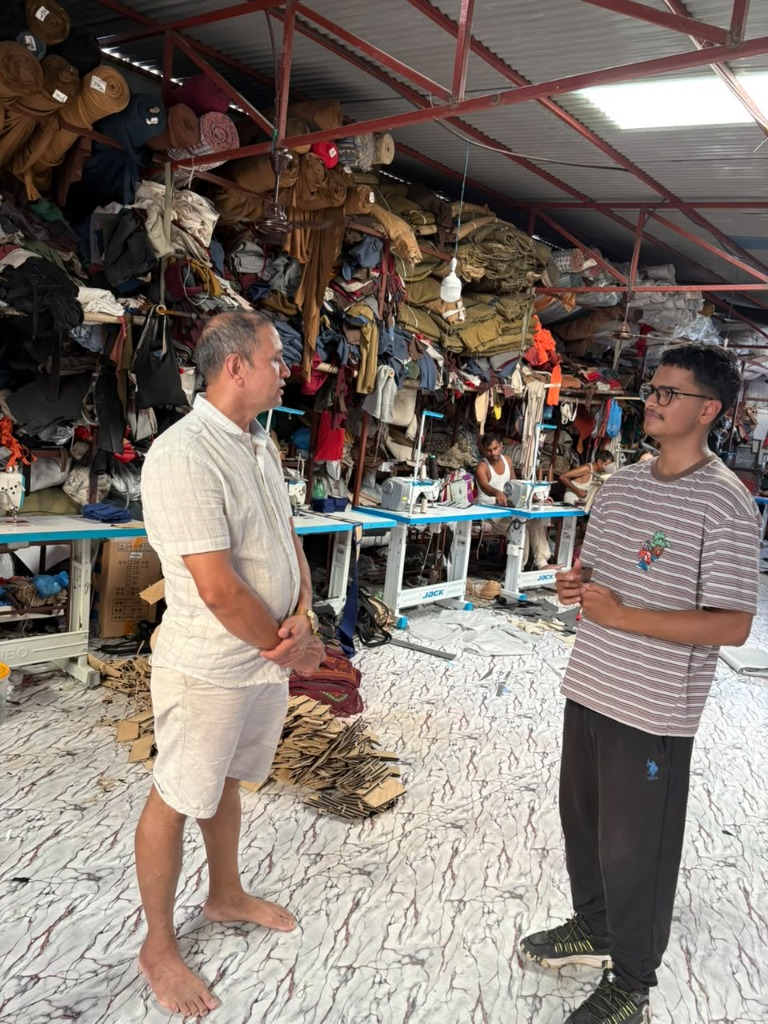
Thirty people, two outlets
Two years on from that first sale, Nabaraj's workshop employs thirty-four people full-time. Most of them are women from surrounding neighbourhoods, many of whom had no formal employment before joining the team. He runs a short in-house training programme for new hires, drawing directly on the production management techniques he observed in Malaysia.
The business now has two retail outlets in Kathmandu — one in Thamel and one in Patan — and a small but growing wholesale line supplying boutique hotels in Pokhara. Monthly turnover has crossed NPR 8 lakh, and Nabaraj says the business has been profitable every month for the past twelve.
He is methodical about how he talks about the numbers — not boastful, but precise in a way that reflects his years on a factory floor where every figure had a consequence. "If you don't know your costs, you don't know your business," he said. "That's the first thing I tell anyone who asks me for advice."
What he brought back that money can't buy
When we asked Nabaraj what made the difference — the thing that separated his business from other returnee ventures we have seen struggle — his answer was not savings or timing or luck. It was systems.
"In Malaysia, I saw how a proper production line works. Nothing is left to chance. Every step has a process, every process has a person responsible, and every person knows exactly what good work looks like. I brought that here. Not the machines — the mindset."
That discipline shows in the workshop. Bags move through the space in a clear sequence: cutting, stitching, quality check, packaging. Defective pieces are flagged at the quality stage, not discovered by customers. Fabric sourced from weavers is logged by batch with the price paid and the cooperative it came from.
"I always wanted to do something for the country. I just needed the skills first — and I had to go abroad to get them."
— Nabaraj Adhikari, founder
The bigger picture
Nabaraj's story is precisely the kind Unfold Nepal exists to document and amplify — not because it is exceptional, but because it is replicable. The conditions that made it work are not out of reach for other returnees: a marketable skill set, a willingness to research before spending, and a founding vision that connects to something larger than personal gain.
"I didn't come back just to make money," he said as we were leaving. "I came back because Nepal has everything it needs. Someone just has to stay and build it."
Are you a returnee with a business idea, or part of the diaspora looking to invest in Nepal's economy?
Keep reading
More from the field
- Ecosystem & Policy
Building it step by step
A conversation with the Rt. Hon. Speaker of the House of Representatives about returnee entrepreneurship, and the advice that is now shaping how we plan the years ahead.